REVIEW · KATHMANDU
PashupatiNath and BoudhaNath – Private/Small Group
Book on Viator →Operated by Amazing Kathmandu Tours · Bookable on Viator
Sacred death rites and prayer wheels in one walk. I love the small-group size (up to 5), because you can actually ask questions without feeling lost in a crowd, and I love how Santosh connects the big ideas of Hinduism and Buddhism through very concrete stories, including Samskaras. In just about 3 hours, you get a guided path that makes religious practices in Kathmandu feel understandable, not mysterious.
The one thing to plan for is cost and access: key areas have extra entrance fees paid in cash at the gate, and at Pashupatinath you won’t be going into the main temple (only Hindus are allowed inside). If you’re the type who hates surprise payments, this tour will be fine, as long as you bring the right cash and keep expectations realistic.
In This Review
- Quick hits before you go
- Pashupatinath: temple rules, meaning, and what you can see
- Aryaghat crematoria: a respectful look at the last rites and 16 Samskaras
- Mrigasthali Deer Park: Shiva’s story you can actually walk through
- Gorakhnath Mandir and Guhyeshwari: from Guru Gorakhnath to Satidevi
- Guhyeshwari to Boudhanath: the Shaktipeeth story lands you at Tibetan Vajrayana
- Guru Lhakhang Monastery: how a typical monastery feels
- Boudha Stupa Thanka Center: thangka art and mandala meaning
- Price and logistics: good value with cash planning
- Who this tour suits best
- My booking verdict: should you book Pashupatinath and Boudhanath
- FAQ
- How long is the PashupatiNath and BoudhaNath private/small group tour?
- What is the maximum group size?
- Where does the tour start and end?
- Is there an entrance fee included in the tour price?
- Which entrance fees are free or included for certain stops?
- What does the guide cover during the Pashupatinath portion?
- What does the guide cover during the Boudhanath portion?
- Is the tour conducted in English?
- Do I get a ticket on my phone?
- Can I get a full refund if I cancel?
Quick hits before you go
- Up to 5 people means more Q and A time with Santosh or your English-speaking guide
- Pashupatinath + Aryaghat gives you a clear look at last rites and the 16 Samskaras
- Boudhanath basics: learn how Tibetan Vajrayana Buddhism is practiced, not just what it is
- Monastery and thangka stop: you’ll see typical monastery life and get hands-on-style art context
- Built-in route logic: the stops are arranged so Hindu and Buddhist themes connect as you walk
Pashupatinath: temple rules, meaning, and what you can see
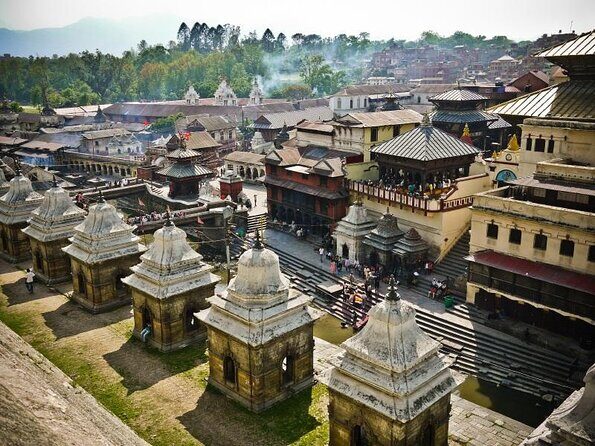
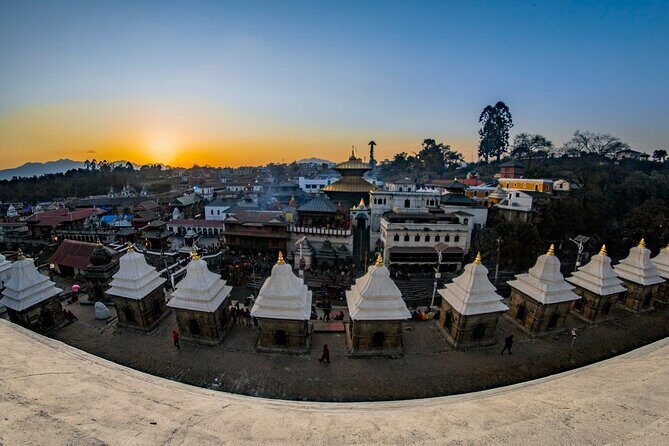
Pashupatinath is one of Kathmandu’s headline Hindu sites, and it’s also a place with strong boundaries. The main temple area has a simple rule: only Hindus are allowed inside the main temple. Practically, this means you’ll still get the atmosphere and important context, but your guide will help you position yourself so you’re seeing what matters without pushing against restrictions.
What I like about starting here is that the guide’s explanations set the tone early. Santosh-style guiding tends to translate big religious concepts into everyday, visible details—where people stand, what rituals signal, and why the site’s role in Hindu life is so important. Even if you’ve read about Hinduism before, you’ll likely find it clicks more once you’re standing in the actual place where devotion happens.
Time tip: Pashupatinath stop time is short (around 15 minutes). That’s enough for orientation and a guided story, but not enough for long wandering. If you want photos, plan to ask your guide first where your best angles are.
You can also read our reviews of more private tours in Kathmandu

Aryaghat crematoria: a respectful look at the last rites and 16 Samskaras
After Pashupatinath, you move toward Aryaghat, the crematoria area. This is the part that can feel heavy on the heart, so go in with a calm mindset. It’s not a theme-park moment. It’s a place where real beliefs about life, death, and continuity are acted out.
The tour’s value here is the explanation. You’re guided through the idea of Shodasha Samskaras—the 16 rites of passage in Hindu life—so what you’re watching (and what you’re being told) has structure. Instead of treating the ceremonies as exotic spectacle, you start to understand them as a system of meaning that ties human life stages to spiritual goals.
One consideration: this stop is listed for about 30 minutes. That’s a quick introduction, not a deep study session. Still, it’s long enough to learn the key terms and notice the sequence your guide points out.
Mrigasthali Deer Park: Shiva’s story you can actually walk through
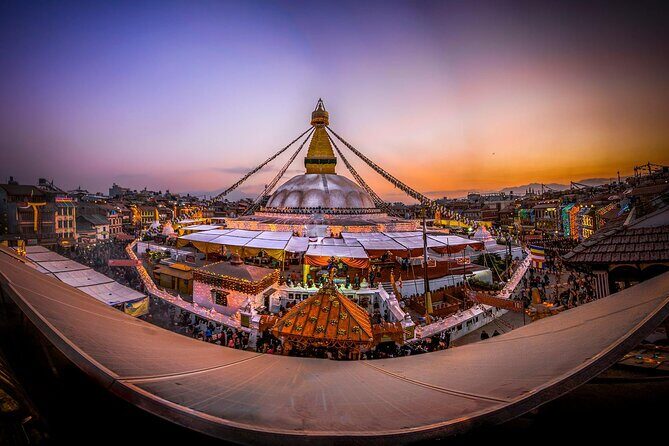
Next comes Mrigasthali Deer Park, a break in tone—but not a random one. Your guide connects the place name and the story of Lord Shiva’s journey to this area. In a short visit (around 15 minutes), you’ll get enough background to stop seeing it as just greenery and start seeing it as part of a living religious geography.
This is also one of the practical places to reset your brain. After a focused rites-and-meaning stop, a small park visit helps you breathe and move before the tour shifts again toward temples tied to Shakti and the Buddhist world of Boudha. If you’re traveling with family members who might not want to linger at more intense spaces, this stop often lands well.
What to watch for: let your guide steer the story, then take a few moments to look around on your own. Even short quiet time helps the rest of the tour feel less like a checklist.
Gorakhnath Mandir and Guhyeshwari: from Guru Gorakhnath to Satidevi
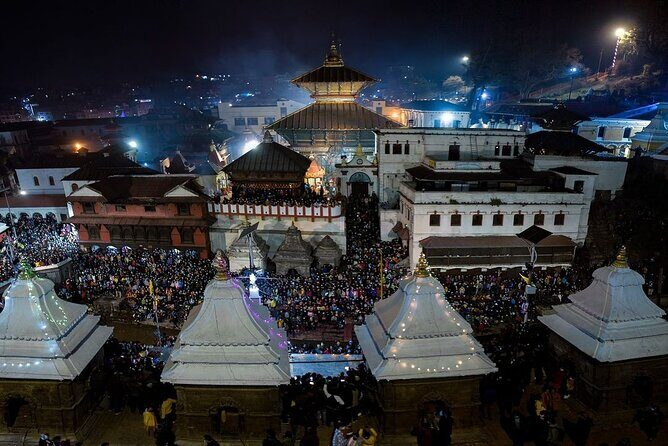
From the deer park, the tour heads to Gorakhnath Mandir Temple. There’s a rest built into this phase (around 30 minutes), which matters because you’ve been walking and listening with your full attention. This temple stop connects to the story of Guru Gorakhnath and sets up a smooth transition toward the Boudhanath area.
Then the route moves toward Guhyeshwari Temple, and that’s where the tour shifts your focus toward the concept of Shaktipeeth. Your guide shares the story of Satidevi and explains why Shaktipeeth matters in Hindu belief. If you’ve only ever heard about Hinduism in broad strokes, this portion helps you see how place-based worship and sacred geography work together.
There’s also a practical timing detail: it takes about 20 minutes to reach Boudhanath from here. That means you’re not spending the day in constant transit. The tour stays compact enough that it feels like one connected walk rather than separate half-days.
Guhyeshwari to Boudhanath: the Shaktipeeth story lands you at Tibetan Vajrayana
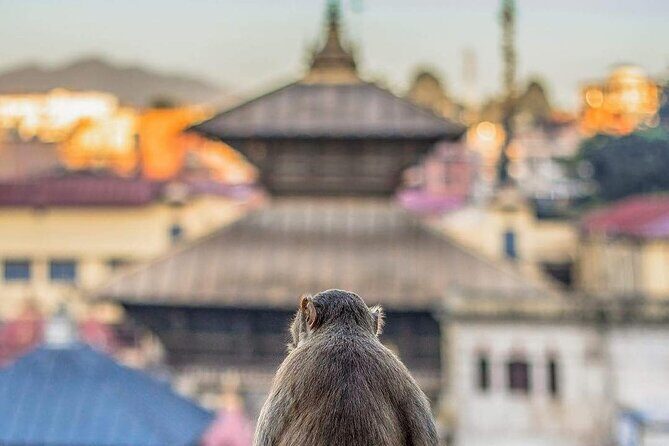
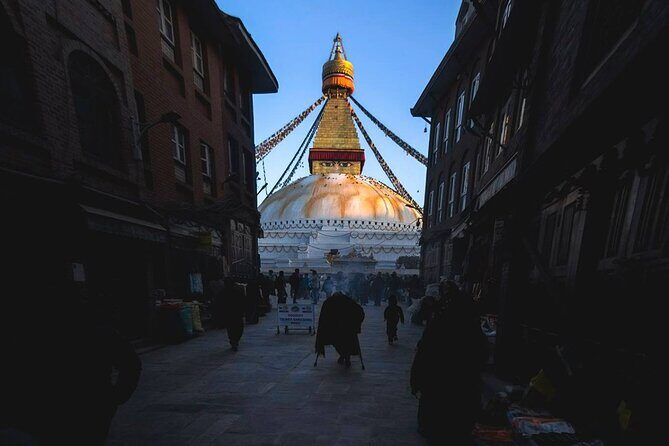
When you reach the Boudhanath area, the change in visual language is immediate—stupa form, prayer practices, and the Tibetan Buddhist setting. The tour uses the Hindu Shaktipeeth story as a bridge, so you’re not just switching religions; you’re learning how Kathmandu layers spiritual traditions in the same city space.
Your guide spends focused time at Boudhanath Stupa (around 45 minutes), treating it as a living teaching space. Since this is described as the second largest stupa of its kind in the world, it also has that “big scale” feeling that’s hard to replicate elsewhere. But the tour doesn’t stop at size. You’ll get explanations that help you identify what people are doing and why.
One of the most helpful parts is that you learn basic Buddhism concepts in plain, tour-friendly terms—things like the idea of prayer flags and the five elements, plus teachings such as the Four Noble Truths and the Eightfold Path concepts. Even if you only catch the main themes, you’ll leave with a framework that makes conversations easier later.




Guru Lhakhang Monastery: how a typical monastery feels
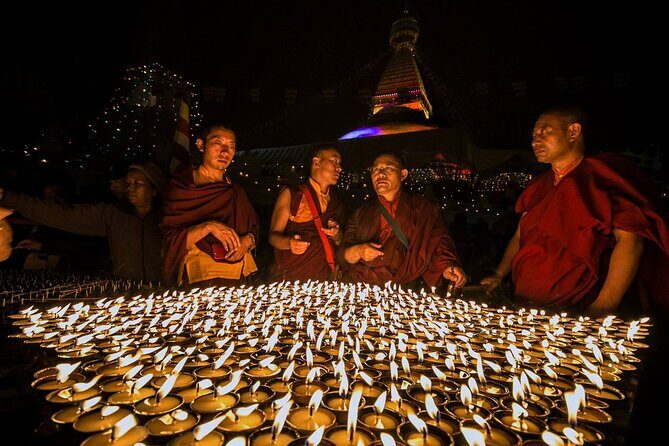
After the stupa, the tour adds a shorter monastery stop at Guru Lhakhang (around 10 minutes). This is a quick but meaningful contrast. Instead of the open stupa courtyard experience, you get a sense of a typical Buddhist monastery space and a story tie-in to Guru Padmasambhava and Dharma Chakra Parivartana.
Because the time is brief, the goal isn’t for you to become an expert. It’s for you to recognize patterns. You’ll see how religious life has a physical form—space, ritual focus, and teaching moments—even when you’re only there for a few minutes.
Tip: Use this stop to ask one good question you didn’t get earlier. With a small group, your guide can usually answer more directly than big-group tours.
Boudha Stupa Thanka Center: thangka art and mandala meaning
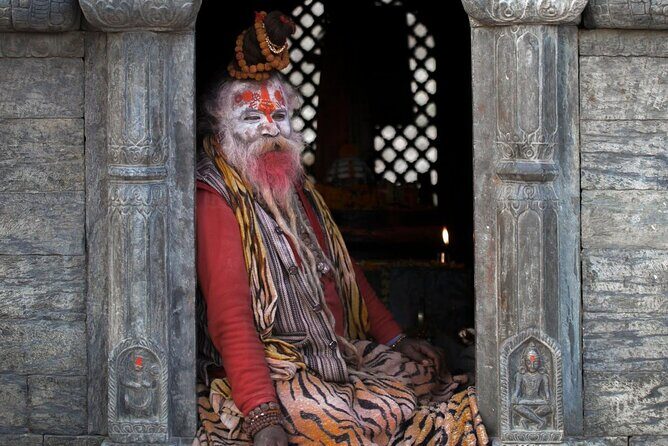
The final cultural layer is at a Boudha Stupa Thanka Center (about 15 minutes). You learn about intricate thanka art, and you get oriented to the idea of mandala. The tour also includes a basics introduction to healing bowls.
This is where the day turns from “religion as explanation” to “religion as art and everyday practice.” It’s also a place where you can buy something meaningful if you want a take-home memory that’s tied to what you just learned—rather than a random souvenir.
Since this stop can be visually detailed, go slow. Let your guide point out what to look for, then choose one or two motifs or design ideas you want to understand. You’ll feel far more satisfied than if you just glance and move on.
The tour ends at the Boudhanath Gate, and you’re free to explore around Boudha on your own afterward.
Price and logistics: good value with cash planning
The listed price is $15.00 per person, and this is often booked about 18 days in advance. That booking window tells me it’s a popular combo tour, likely because it covers two of Kathmandu’s most important religious sites in one go.
Here’s the value math: the tour includes an English-speaking guide and uses a mobile ticket, which reduces hassle at the start. But entrance fees are not included. You’ll pay cash at the entrance: about NRP 1000 for Pashupatinath and about NRP 400 for Boudhanat (with those extra costs listed as about $13.00 per person total). Some other stops have admission included (Mrigasthali Deer Park and Gorakhnath Mandir Temple), and one stop is listed as admission free (Guhyeshwari Shaktipeeth Temple).
So the real question isn’t just “is it cheap?” It’s “does the guide time make up for the extra gates?” In my view, yes—because the guided explanations turn difficult-to-interpret spaces (like Aryaghat) into something you can understand, not just something you can photograph. Without a guide, you’d likely miss the logic behind what you’re seeing.
Logistics tip: bring cash before you start, so you’re not scrambling when you reach the gates.
Meeting point note: the tour begins at Gaushala Bus Stop (Ring Rd), and ends at Boudhanath Gate. That’s convenient because it drops you right where you may want to continue wandering.
Who this tour suits best
This is a strong fit if you want more than temple selfies. You’ll enjoy it most if you like asking questions and you’re curious about how Hindu and Buddhist life co-exist in Kathmandu.
It also suits people who appreciate structure: you’re shown a tight sequence—Pashupatinath, crematoria context, a Shiva-linked park stop, Hindu Shakti concepts, and then Boudhanath Buddhist fundamentals—so your day has a narrative.
If you’re extremely sensitive to death-related ceremonies, treat Aryaghat as a “prepared and respectful” stop. You’re there for understanding, not entertainment.
My booking verdict: should you book Pashupatinath and Boudhanath
Book it if you want a small-group Kathmandu religious tour that connects Hinduism and Buddhism with real explanations, not vague commentary. The best reason is the guide-led storytelling approach—especially the way the tour frames the 16 Samskaras and then carries that thinking forward into Boudhanath’s Tibetan Vajrayana world.
Skip it only if you want a long, self-paced tour with no entrance fees and no structured stops. This is built as a compact guided route. If that style matches how you like to travel, it’s a solid choice.
If you do book: bring some cash for the gates, come with one or two questions you care about, and expect this to feel meaningful—sometimes quietly, sometimes intensely.
FAQ
How long is the PashupatiNath and BoudhaNath private/small group tour?
It lasts about 3 hours.
What is the maximum group size?
The tour has a maximum of 5 travelers.
Where does the tour start and end?
It starts at Gaushala Bus Stop (Ring Rd, Kathmandu) and ends at the Boudha Stupa gate.
Is there an entrance fee included in the tour price?
No. Entrance fees for Pashupatinath and Boudhanat are not included and must be paid in cash at the entrance.
Which entrance fees are free or included for certain stops?
Mrigasthali Deer Park and Gorakhnath Mandir Temple list admission as included. Guhyeshwari Shaktipeeth Temple lists admission as free. Boudhanath Stupa lists admission as not included.
What does the guide cover during the Pashupatinath portion?
The guide explains Hinduism basics, including last rites and the 16 Samskaras.
What does the guide cover during the Boudhanath portion?
You’ll learn Buddhism basics tied to Tibetan Vajrayana Buddhism, including topics like prayer flags, five elements, Four Noble Truths, and Eightfold Path concepts, plus monastery and art explanations later.
Is the tour conducted in English?
Yes. The tour includes an English-speaking guide.
Do I get a ticket on my phone?
Yes. It includes a mobile ticket.
Can I get a full refund if I cancel?
Yes, free cancellation is available up to 24 hours before the experience starts. If you cancel within 24 hours, the amount paid is not refunded.