REVIEW · KATHMANDU
UNESCO Five World Heritage Tour in Kathmandu
Book on Viator →Operated by Himalayan Advisor Pvt. Ltd. · Bookable on Viator
Kathmandu can feel like a blur, but this private UNESCO day plan keeps it organized and meaningful. You’ll hit major World Heritage sites with a professional guide, plus hotel transfers within the Ring Road area (including Bouddha). Two big wins for me: you get entrance tickets included and you’re spared the taxi hassle. One consideration: it’s a lot of sacred stops in one day, so you’ll want comfy shoes and patience with crowds and staircases.
What makes this route special is the way it stitches together Buddhist and Hindu Kathmandu. You start on the Swayambhu hill, move through the royal courtyards of Kathmandu and Patan, then end at two of the Valley’s most powerful spiritual hubs: Pashupatinath and Boudhanath. If you book with a guide like Shanti (or Shanthi), you can expect clear context, sharp explanations, and a day that feels stress-free and well-timed.
In This Review
- Quick hits: what makes this day tour work
- Why this 9:00 a.m. UNESCO Kathmandu Valley circuit feels efficient
- Price and value: what $130 covers (and why it’s fair)
- Getting around with a private car and Ring Road pickup
- Swayambhunath and Amideva Buddha Park: the morning hilltop mix
- Kathmandu Durbar Square in stages: Basantapur Tower, Taleju, Kumari Chowk, Kaal Bhairab
- Patan Royal Palace and Patan Durbar Square: Newari craft in Lalitpur
- Golden Temple in Patan and the Patan Museum pause you’ll be glad you took
- Vishwanath Mandir, Bhimsen Temple, then Pashupatinath: shifting from craft to devotion
- Boudhanath Stupa: the day’s spiritual exhale with prayer wheels and scale
- Guide-led commentary is the difference between seeing and understanding
- What to pack and how to pace a long 7 to 8 hour heritage day
- Who this UNESCO Kathmandu Valley tour is best for
- Should you book this 7 UNESCO World Heritage day in Kathmandu?
- FAQ
- What time does the tour start?
- How long is the tour?
- What’s included in the price?
- Are meals included?
- Is this a group tour?
- Do I need to pay entrance fees separately?
- Where does pickup happen?
- Can I get a full refund if I cancel?
Quick hits: what makes this day tour work
- 7 UNESCO sites in one sweep: you’ll cover the big names without stitching together tickets and rides yourself
- Entrance fees included at every stop, so you spend time looking instead of negotiating
- Ring Road pickup (including Bouddha area) keeps the logistics from eating your morning
- A guide-led route that ties sites together, especially where Buddhist and Hindu traditions overlap
- Professional drivers and tight timing: the day runs smoothly even with lots of moving parts
- Patan + Kathmandu together: you get both royal squares and the Newari craft vibe in Lalitpur
Why this 9:00 a.m. UNESCO Kathmandu Valley circuit feels efficient
Starting at 9:00 am, this tour is built for people who have limited time but still want the real Kathmandu Valley hits. The big idea is simple: instead of choosing between places like Swayambhunath, Durbar Squares, Patan, and the two major religious complexes, you do them all in one day with the same car and the same guide.
That matters, because Kathmandu is not just sightseeing. It’s temples, courtyards, and stairways packed into tight neighborhoods. When you do this on your own, you end up juggling navigation, entrances, and ride timing. With this setup, you can follow the story in order—hilltop to royal square to craft-focused Patan to devotional powerhouses—without losing half the day to logistics.
You can also read our reviews of more historical tours in Kathmandu

Price and value: what $130 covers (and why it’s fair)
At $130 per person, the value is less about the number and more about what’s included. You’re paying for a private car, a professional guide, entry fees for all heritage sites, and hotel pickup/drop-off within the Ring Road area (including Bouddha). For a day that visits multiple UNESCO-listed sites, that bundle is where the money makes sense.
If you’ve ever priced similar days in many cities, you know the pattern: once you add admission tickets, a guide, and multiple rides across town, the total can jump fast. Here, the tour keeps the “ticket + guide + transport” parts handled together. Your budget stays predictable.
One more subtle win: included entry fees remove a certain kind of mental load. You don’t have to switch modes from sightseeing to budgeting and bargaining every time you arrive at a gate. The guide handles the entry part, then you can focus on what you’re actually seeing.
Getting around with a private car and Ring Road pickup
This is a private tour, so it’s only your group in the vehicle. That’s not just comfort—it’s control. You can take the slower moments when you want, and you’re not stuck syncing your pace to strangers who want photo breaks every five minutes.
Pickup is offered inside the Ring Road area, including the Bouddha area. If you’re staying near the main ring, you’ll likely start the day with less friction. If you’re staying outside that zone, you’d want to confirm before booking, because the provided pickup coverage is specifically framed around the Ring Road.
The day runs about 7 to 8 hours, which is long enough to see a lot but short enough that you’re not committing to a full-day travel marathon with constant “wait, wait, wait.”
Swayambhunath and Amideva Buddha Park: the morning hilltop mix
Your first major stop is Swayambhunath Stupa, a UNESCO World Heritage Site that matters to both Buddhist and Hindu communities. This is the kind of place where the spiritual mood hits immediately: the hilltop setting, the focused reverence, and the way different traditions live side by side in Kathmandu.
Plan on spending about one hour here. It’s not just staring at a stupa. It’s observing how people move—where they pause, what they circle, and how the setting shapes the experience. Swayambhunath is also a great orientation stop. After you’re up there, the rest of the day’s sites start to feel connected.
Right near the hill is Amideva Buddha Park, a quick 15-minute stop with three large statues of Shakyamuni Buddha. This is the “breather stop” in the morning. It’s close, it’s pretty, and it gives you a calmer moment before you drop back into the dense palace-square energy.
If you like your spiritual visits to include both big, iconic monuments and smaller artistic spaces, Amideva Buddha Park is a nice balance.
Kathmandu Durbar Square in stages: Basantapur Tower, Taleju, Kumari Chowk, Kaal Bhairab
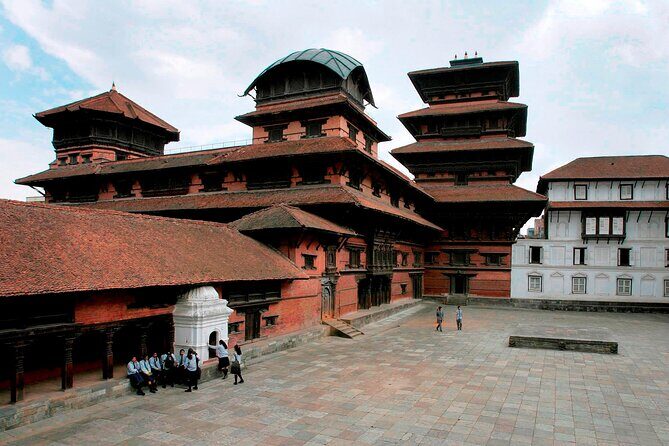
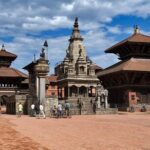
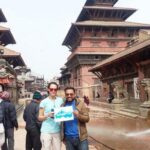
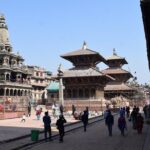
Then the tour moves into Kathmandu Durbar Square, a royal courtyard packed with historic and religious architecture. One practical detail here: some structures are being reconstructed, so you might see parts under restoration. That’s not a problem. It’s actually helpful context. Kathmandu’s heritage isn’t locked in time—it’s living, maintained, and rebuilt after damage.
You’ll spend about one hour total in the Kathmandu Durbar Square area, with several smaller stops:
- Basantapur Tower (about 30 minutes): a classic Durbar Square viewpoint and landmark. It’s a good “get your bearings” moment inside the complex.
- Degu Taleju Temple (about 10 minutes): Taleju Temple was built in 1564. Even in a short stop, it gives you a sense of how royal power and devotion got fused in the old days.
- Kumari Chowk (about 10 minutes): this is the courtyard associated with the Kumari, the living goddess selected until puberty. If you’re interested in local religious customs, this stop tells you a lot about how devotion can be embodied.
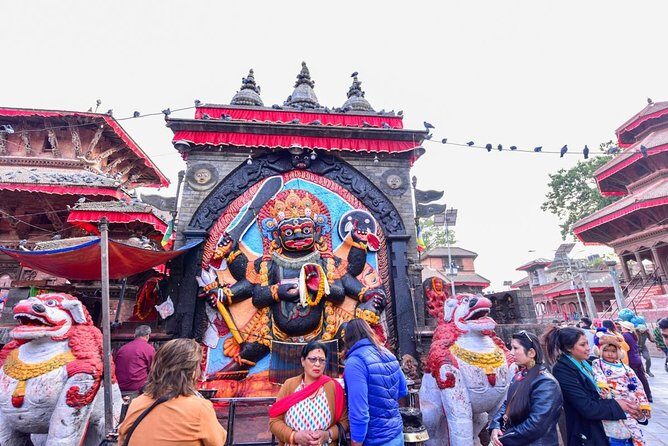
- Kaal Bhairab (about 5 minutes): a statue of Bhairav. Quick, but memorable because it rounds out the square with another layer of Hindu devotional presence.
A big reason I like how this is structured: it’s not one long wait in a single spot. The day keeps you moving through smaller, meaning-rich stops. The drawback is obvious too: it can feel tight on time if you want to linger. If you’re the type who needs slow wandering, plan to ask your guide for extra time at the two or three places you care about most.


Patan Royal Palace and Patan Durbar Square: Newari craft in Lalitpur
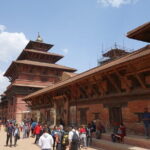
After Kathmandu’s royal square energy, you head to Patan (Lalitpur) and the royal-palace zone. You’ll visit Patan Royal Palace (about 1 hour) first, around Durbar Square of Patan. Expect a dense cluster of heritage sites like the Krishna Temple and nearby temples, plus the sense that Patan is its own world.
Then comes Patan Durbar Square (about 45 minutes). This is where Newari architecture becomes the star. You’ll see temples and artistic creations tied to the Newar community’s long tradition of carving, building, and maintaining sacred spaces. Patan is often where people start to notice that Kathmandu’s heritage isn’t one style. It’s a whole set of local craftsmanship stories.
The value here is how the two cities complement each other. Kathmandu’s square feels connected to its royal past in a certain way; Patan’s feels like a working museum of Newari design.
If you’re a first-time visitor, I’d treat Patan as the “architecture and detail” section of your day. Look at windows, columns, and carvings more than you think you’ll need to. This is one of those days where the guide’s commentary helps you understand what you’re looking at, not just where to stand for photos.
Golden Temple in Patan and the Patan Museum pause you’ll be glad you took
Two quick add-ons make this section feel richer than a rushed square-hop:
- Taleju Mandir Temple (about 15 minutes): rebuilt after a fire in 1676 by Srinivasa Malla. It’s a reminder that these places survive through restoration and continuity.
- Patan Museum (about 15 minutes): this one’s worth your time if you like objects and context. Inside, you can observe older statues, carved windows, and wooden pillars. Even if you’re not a museum person, it helps you connect the art you saw outside to the cultural meaning behind it.
Then you reach Golden Temple (Hiranya Varna Mahavihar) (about 10 minutes). It’s a 12th-century pagoda-style temple with bronze statues. The decorations are described as silver and golden, and there’s a golden image of Lord Buddha. This stop tends to work for nearly everyone because it’s striking without requiring deep prior knowledge.
Short stops like these are a smart tactic in a day as packed as this. They keep you from running on adrenaline only. You slow down, look closer, and your brain has something to hold onto besides “I saw a lot.”
Vishwanath Mandir, Bhimsen Temple, then Pashupatinath: shifting from craft to devotion
After the Golden Temple area, the tour includes two more temple stops in the Patan sphere:
- Vishwanath Mandir Temple (about 5 minutes): built during the reign of Siddhi Narsingh Malla and dedicated to God Shiva.
- Bhimsen Temple (about 15 minutes): built in 1680 by Srinivasa Malla, worshiped as a god of business and trade by the Newar community.
These are short, but they’re useful. They show you that religion in Kathmandu Valley isn’t only about grand monuments. It’s also about everyday roles—work, exchange, protection, identity.
Next, you head to Pashupatinath Temple (about 1 hour), a Hindu complex with over 500 shrines and temples. It’s presented as the main temple for Shiva devotees. The scale here changes the feel of the day. Where Durbar Squares focus on palace-courtyard architecture, Pashupatinath is a devotional ecosystem of temples, pagoda structures, and shrines clustered in a large complex.
This is also where you’ll notice how the day’s Buddhist and Hindu themes keep interweaving. Kathmandu isn’t compartmentalized. It’s overlapping.
Boudhanath Stupa: the day’s spiritual exhale with prayer wheels and scale
The last major stop is Boudhanath Stupa (about 1 hour). It’s described as a symbol of Nepal’s Buddhist influence, with a large dome-shaped structure measuring 36 meters high. You’ll also see prayer wheels and picture carvings connected to Buddha.
If you’ve been walking through crowded squares for hours, Boudhanath offers a different kind of calm. People don’t always approach it like a checklist item. Many arrive to circle, pause, and absorb the atmosphere. The stupa’s scale also gives your eyes a place to rest.
One practical thought: expect the day to feel full. Boudhanath closes the loop—hilltop, royal squares, Patan’s detail, Shiva devotion at Pashupatinath, and then Buddhist focus at a giant stupa.
Guide-led commentary is the difference between seeing and understanding
This tour really leans on the guide. The strongest feedback is consistent: guides like Shanti/Shanthi, Sarita, Tej, and Rabina are praised for being professional, polite, attentive, and quick to answer questions with real substance.
I especially like the way the best guides frame what you’re seeing. Instead of treating each stop like a separate photo op, they explain how religions and traditions evolved together in the Kathmandu Valley. That changes how the day lands in your mind. You stop thinking of Kathmandu as random temples and start seeing patterns.
If you want the most from your money, ask your guide a simple question early on: how do Buddhist and Hindu traditions show up differently across these sites? A good guide will give you an answer you can reuse at the next stop.
Timing also matters. Several people described guides whose pacing and scheduling felt tight. In a day like this, that’s a big deal. When the timing is right, you don’t spend your energy on stress.
What to pack and how to pace a long 7 to 8 hour heritage day
Food and drinks are not included. That’s the one “you need to plan around it” item in the data. With a day this full, you’ll want a simple strategy for energy.
I suggest you bring:
- water (if allowed where you are; rules can vary by site)
- a light snack you can eat during transitions
- sun protection, since parts of the route sit out in the open
- comfortable shoes for uneven stones and lots of stair steps
Pacing tip: pick your top two places and give yourself permission to linger there. Everything else you treat as “watch and learn” rather than “spend forever.” Otherwise the day can start to feel like you’re trying to win a walking contest.
Who this UNESCO Kathmandu Valley tour is best for
This works best if you:
- want a single-day UNESCO-focused overview of Kathmandu Valley’s major sites
- care about architecture and cultural context, not just photos
- prefer a private, guide-led route with entrance fees handled
- are staying in or near the Ring Road area (including Bouddha)
It may be less ideal if you:
- hate long days on your feet
- want lots of free time to wander without guidance
- need food to be included (because it isn’t)
If you’re visiting for a short stopover and want the “Kathmandu must-sees” covered, this kind of structured day is a smart use of time.
Should you book this 7 UNESCO World Heritage day in Kathmandu?
My honest take: yes, if your goal is an efficient, meaningful UNESCO highlight day with private transport, a professional guide, and admission fees included. The route makes sense as a storyline, and the guide component is strong enough that you’ll likely remember what you learned, not only what you saw.
Book it if you like structure. If you hate structure, look for a more flexible plan. But for most people with limited time, this is a clean, value-heavy way to experience Kathmandu Valley’s most important sacred and royal sites in one go.
FAQ
What time does the tour start?
The tour starts at 9:00 am.
How long is the tour?
It lasts about 7 to 8 hours.
What’s included in the price?
The price includes private transport by car, a professional guide, entry fees for all heritage sites, and hotel pickup and drop-off within the Ring Road area (including Bouddha area).
Are meals included?
No. Food and drinks are not included.
Is this a group tour?
It’s described as private, meaning only your group will participate.
Do I need to pay entrance fees separately?
No. Entry fees are included for the heritage sites visited.
Where does pickup happen?
Pickup is offered inside the Ring Road area, including the Bouddha area.
Can I get a full refund if I cancel?
Yes. Free cancellation is available, and you can cancel up to 24 hours in advance for a full refund. If you cancel within 24 hours of the start time, the amount paid is not refunded.